FINAHQ

Close, consolidation and statutory reporting for groups

For groups running many companies on Tally, SAP, Oracle or QuickBooks. FINAHQ reads each company's books, closes the group and produces the statutory statements. SNR Sons Charitable Trust went from a 15-day close to 2 days.

One group, seven systems
TallyPrimeXML interface
SAP S/4HANA / ECCOData (SAP's API)
Oracle FusionGL Balances API
Oracle NetSuiteStandard interfaces
Microsoft Dynamics / NavisionScheduled export
QuickBooksOAuth 2.0
Zoho BooksScheduled export
Written backNothing, on any of them

Every connection is read-only. Exactly how each one is read, and the versions supported: on the integrations page.

The product

The product, not a mock-up

Seven screens from FINAHQ and Munshi, from the consolidation workspace to statements ready to file. Shown on Good Group, the demo companies used across this site.

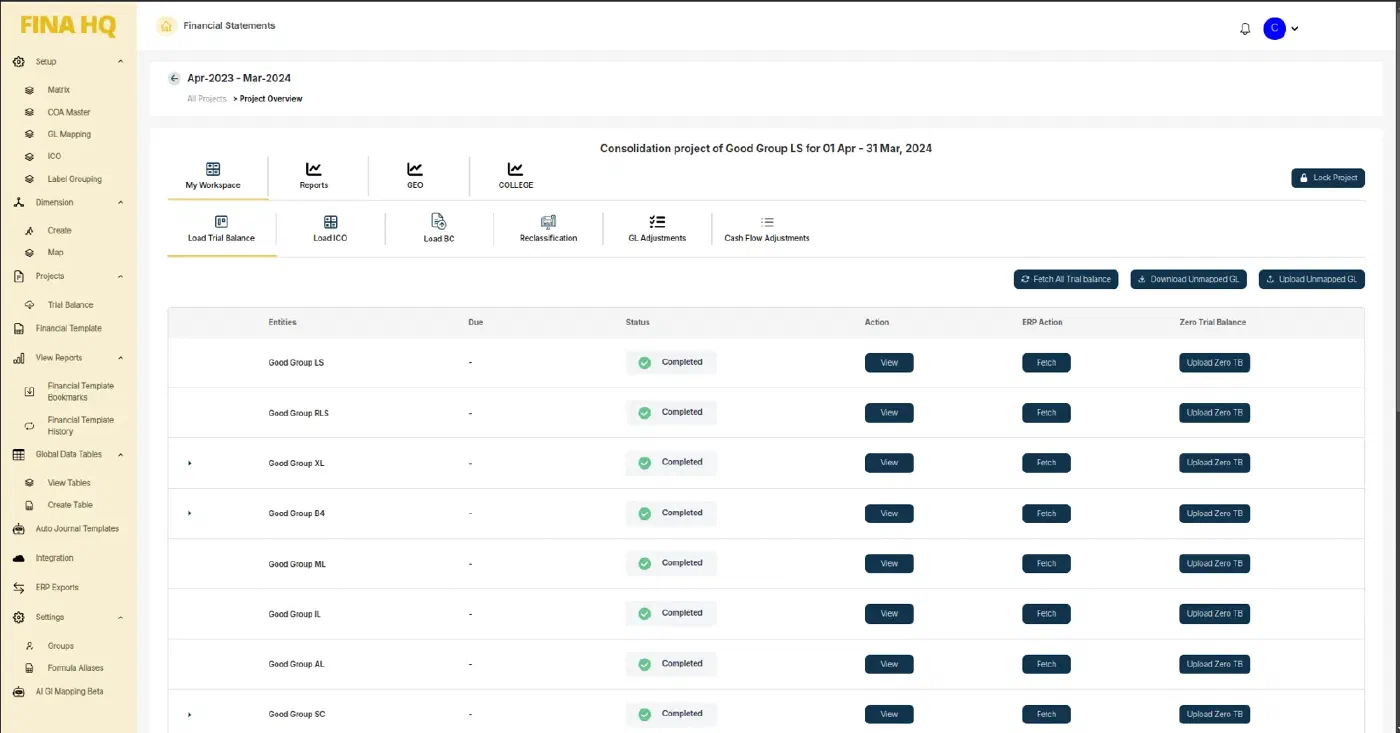
The FINAHQ workspace for a Good Group consolidation project, with tabs for trial balances, intercompany, reclassification and adjustments, and a list of companies each marked Completed.
The period's workspace. Load each company's trial balance, fetch it from the ERP or upload it, then work through intercompany, reclassifications, GL and cash flow adjustments from the same screen. A company that has not arrived shows here before it holds up the close.
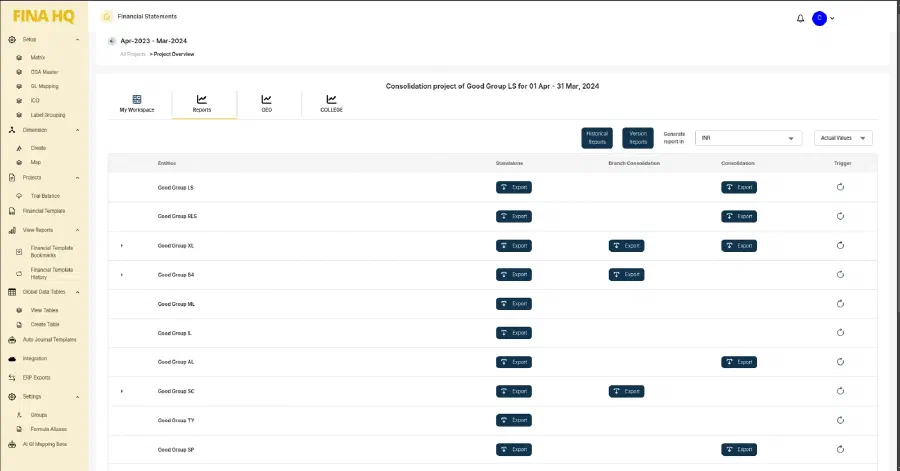
The FINAHQ reports tab for a Good Group project, with export buttons per company for standalone, branch consolidation and consolidation.
Standalone and consolidated, side by side. Each company's standalone pack, its branch consolidation where it has branches, and the group consolidation, each one export away.
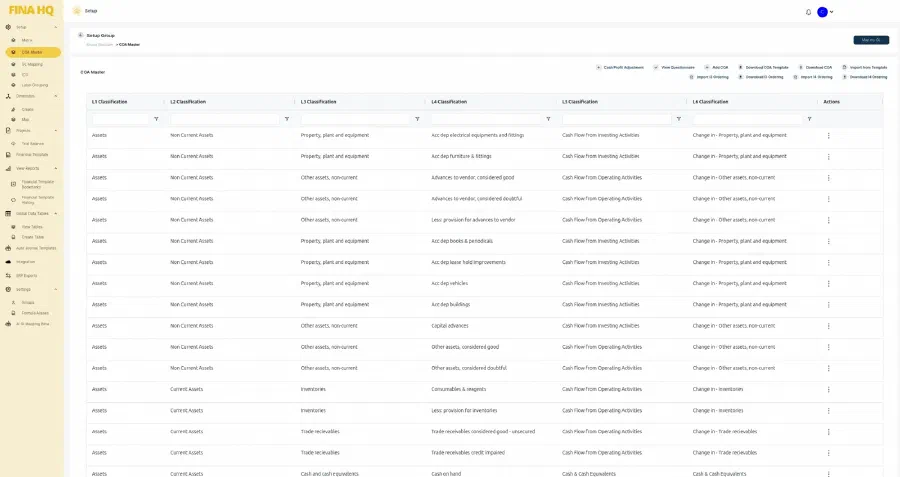
The FINAHQ chart of accounts master, each account classified at six levels from Assets through to its cash flow line.
The group chart of accounts. Mapped once during onboarding, down to the cash flow line, and carried into every period after that.
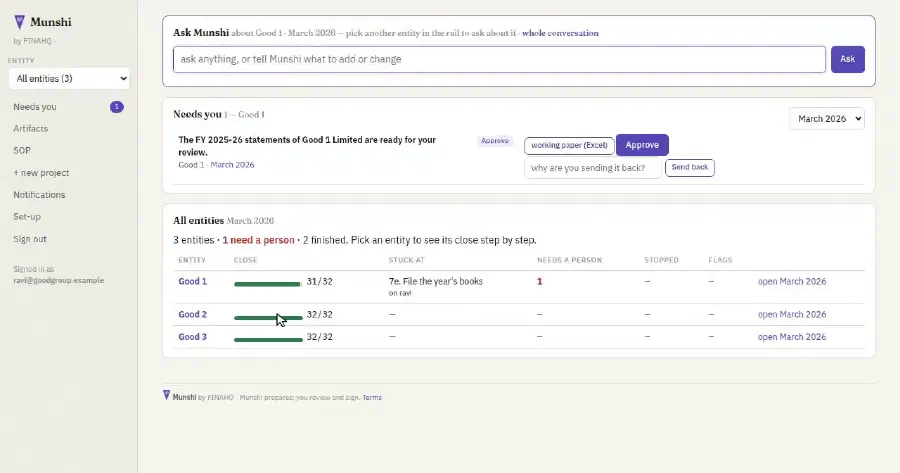
Munshi's group view for March 2026: Good 1 at 31 of 32 steps with one item needing a person, Good 2 and Good 3 at 32 of 32.
The whole group's close at a glance. Every company's progress, what it is stuck on, and the one thing that needs a person.
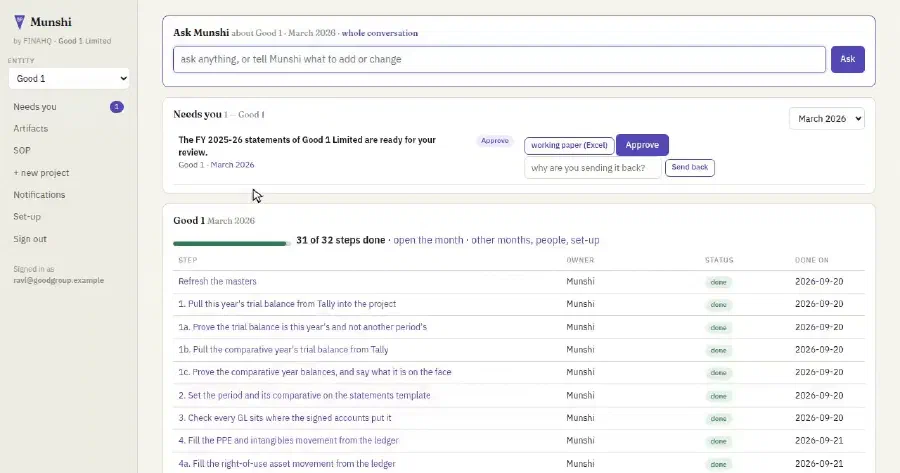
Good 1's close plan for March 2026 showing 31 of 32 steps done, each step with owner Munshi, status done and a completion date.
A 32-step close plan, run for you. Each step with its owner, status and date, from pulling the Tally trial balance to filing the year's books.
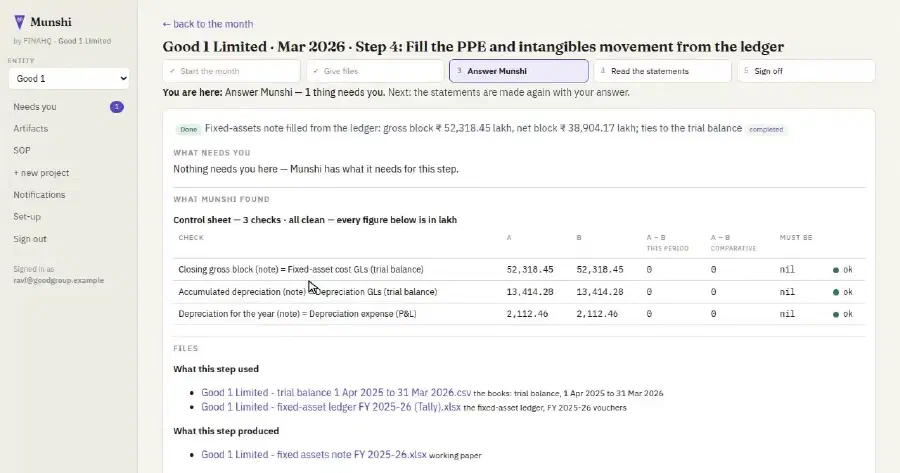
The step page for filling the PPE and intangibles movement, with a control sheet of three checks, all passing, and the source files listed.
Every figure checked against the ledger. A step's control sheet: both figures, the difference, and whether it passed, with the files it used and produced.
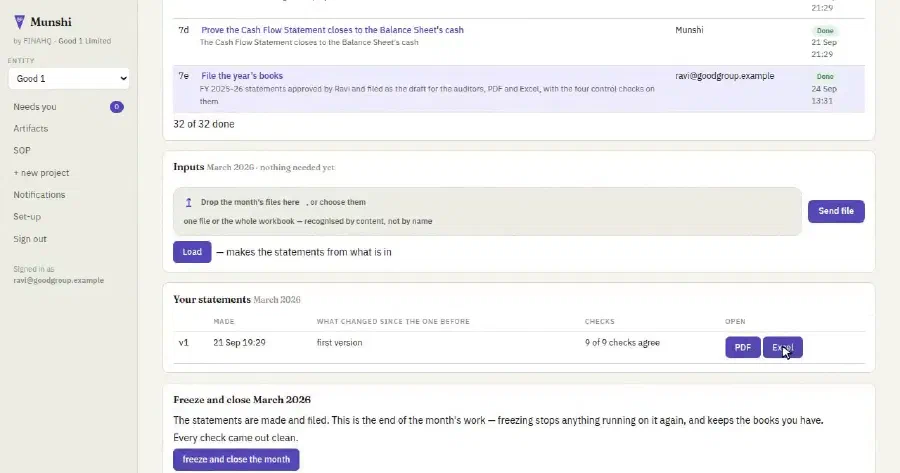
Good 1's March 2026 close complete at 32 of 32 steps, with the statements available as PDF and Excel and a button to freeze and close the month.
Statements ready to file. All 32 steps done, the statements out as PDF and Excel, and the month ready to freeze.

What it does

What FINAHQ does

New accounting rules arrive as updates

Framework-level changes — like IFRS 18 (Presentation and Disclosure in Financial Statements, replacing IAS 1) and its Indian equivalent, Ind AS 118 — are managed through amendments to the tool. When a reporting framework moves, the templates, mappings and statements move with it, rather than each group rebuilding its reporting to catch up.

Intercompany and eliminations

Intercompany balances matched and eliminations applied automatically, not reconciled by hand each period.

Consolidation

Consolidate across Tally companies, SAP company codes, Oracle ledgers and QuickBooks entities, with multi-currency translation.

SEBI reporting

The quarterly disclosure your listing requires under SEBI LODR, ready from your close.

FINAHQ is for finance teams that close more than one company. It connects to each company’s ERP read-only and maps every ledger once to a group chart of accounts. Then it runs the close, intercompany, consolidation and statutory statements on that one set of data. Click any line in a statement and the ledger detail is underneath it.

How it works

  • The engine reads your books, maps them and computes the statements. This is the part your auditor checks.
  • MCP (AI tool protocol) lets the tools your team already uses call that same engine: load a trial balance, run the intercompany reconciliation, tie the statements. See the calls.
  • Munshi is the agent that runs the close on the engine. It asks your people only what no ledger can answer, and records who approved what.
What fills itself in ~90% of a close, from source data
  1. Trial balance ~50%
  2. Ledgers, subledgers and day books to about 90%
  3. Structured Excel you already keep to about 90%
  4. Judgment, and the things only your group knows the rest

No data-entry project first. It reads what you already keep.

The last part stays with you on purpose. FINAHQ copies your accounts as they are and keeps your own formulas. A plugged figure is flagged the moment it is read. A difference that won’t reconcile is shown as a difference and parked in a control account, and the close carries on.

Your statements come out in the format you already sign off, as Excel workbooks. Reporting under Ind AS and IFRS? Both sets come from the same mapped ledgers, with no second close.

Been let down before?

Veranda, a BSE-listed education group, had tried other tools first:

They had tried other tools first Veranda Learning Solutions Finance team
Read the transcript

So, before trying FINAHQ we have tried many other products. I mean it generally it did not work. I mean the expectations we had from the system I mean mostly we were not satisfied from other tools and having those experiences considering FINAHQ that point of time we are very skeptical you know a typical account and mindset.

You don’t have to take our word for it. We will read your own trial balance first, before you sign anything.

FINAHQ is built for groups. If you report on one company there is nothing to consolidate, and FINK is the better fit.

How it connects

Every connection is read-only, and nothing is written back to any ERP. Your own IT team issues the credential and can revoke it. See all seven systems, with versions, and what IT will ask, answered in full.

Pricing, and reading by role

There is no price list. The value calculator gives you an indicative price and the benefit for your group, and what it costs lists what moves it. Reading as a group controller or a group CFO? Start there.

Latest change Ind AS 118 and the 2026 amendment rules, worked through before they apply Everything that has changed, and why

Where the days go

What actually takes the time in a close

How much of the close's effort FINAHQ takes off, on average.

6.4 fewer days on the close, for a 7-person finance team closing 10 companies on TallyPrime.

10.0 days today, 3.6 days with FINAHQ.

See it step by step
For a 7-person team closing 10 companies on TallyPrime, taking 10.0 days to consolidated numbers today. Measured on existing client engagements and approximate, not a promise. A different team size, company count or ERP mix is a different shape and these days should not be read across to it — the calculator computes from your own answers.
What the close is made ofDays todayDays with FINAHQDays savedWhat changes
Collect trial balances from every company1.50.51.0Nobody exports, emails or pastes a file. Trial balances and entries arrive from each ERP on a schedule, on their own.
Clean up and map ledgers to the group format1.50.51.0Nothing to re-map every month. FINAHQ proposes the mapping once from your signed accounts, your team approves it, and only new ledgers ever come back for a decision.
Chase companies and teams for schedules and confirmations1.00.40.6The chasing stops being your job. Munshi asks each owner directly for what only they have, follows up on its own, and keeps the approval record your auditors will ask for.
Match intercompany balances and agree differences1.50.51.0Your team spends its time agreeing differences, not hunting for them. Balances are matched across companies automatically and listed by counterparty.
Eliminations, currency translation and minority interest1.00.30.7Nothing recomputed by hand each period. Eliminations, translation and minority interest run from rules set once and are simply reviewed.
Draft balance sheet, P&L and cash flow1.00.20.8Statements are ready in your own format, in Excel, not assembled from scratch. They come straight from your approved Ind AS templates.
Prepare notes and disclosures1.50.70.8Most notes fill themselves from ledger and subledger data. What's left has a named owner and a sign-off, not a blank Excel tab.
Review, tie-out and audit queries1.00.60.4Audit questions get answered on screen, not chased over email. Every number opens down to company, ledger and entry.
Across the whole close10.03.66.4Each component's share of the reference close, multiplied by how much of that component is taken off. Your own team size, company count and systems change it, which is what the calculator is for.

Proof

What changed

FINAHQ impressed us from day one. The implementation was seamless, far faster than we anticipated.

More than 70% off Ind AS statement preparation time

Ramdas Parameswaran CFO Acko Life Insurance

We went from a 15-day close to 2 days. The platform handled our 20+ entities across multiple ERPs with accuracy we hadn't seen before. GL mapping got to 90% on the first run.

15 becomes 2 days

Working days to consolidated numbers

Seshadri Subbaraman CFO SNR Sons Charitable Trust

FINAHQ cut our quarterly consolidation effort by more than 75%.

More than 75% off quarterly consolidation effort

Nikhila R Group CFO Swelect Energy Systems Ltd

Every result here is that customer's own, published with their permission.

What we have written for Group controller, audit committee readers

All articles

Questions

Commonly asked

Does this replace our ERP?

No. FINAHQ reads your ERPs read-only and does the group reporting on top. Your companies keep running on whatever they run on today.

What does our auditor see?

Every figure traces back to the journal entry it came from. Adjustments are approved entries, never typed over a figure. That trail is what an audit asks for.

How much of the mapping do we have to do?

The first mapping is onboarding, and FINAHQ does it — that's our heavy lifting, not yours. After that, when a new general ledger account shows up, AI suggests the mapping, close to 90% accurate, and you accept or change each suggestion before it's used.

We have been promised ERP connectivity before and it did not work. Why is this different?

It is the objection we hear most. Ask for a connectivity test on your own system before you commit: your IT team, your credentials, your data. You will know inside one session, before any onboarding fee.

Can it run inside our own infrastructure?

Yes, including on-premise. The trust page sets out the deployment options.

FINAHQ, Munshi and FINK are all offered by Ananta Technology Services LLP.

See what this is worth to you