Stop closing the books twice — once for compliance, once for the business

Software for the group close, consolidation and management reporting. One group went from a 15-day close to 2 days across 20+ entities, without replacing Tally: SNR Sons Charitable Trust, which runs Sri Ramakrishna Hospital.

Six entities, three systems, one trial balance

Revenue from operations by entity, INR lakh, FY 2025-26
EntitySourceRevenue
Good IndustriesTally Prime48,200
Good ComponentsTally Prime12,400
Good PolymersSAP S/4HANA9,650
Good LogisticsOracle Fusion5,180
Good FZEOracle Fusion7,320
Good ServicesTally Prime2,140
Group, before eliminations84,890

Intercompany nets off

Intercompany trading and interest eliminated on consolidation, INR lakh
BetweenRaisedEliminated
Good Components to Good Industries Components supplied to the parent4,280(4,280)
Good Polymers to Good Industries Moulded parts supplied to the parent1,640(1,640)
Good FZE to Good Industries Traded goods supplied to the parent530(530)
Good Industries to Good Components Interest on the loan to Good Components220(220)
Good Industries to Good Polymers Interest on the loan to Good Polymers160(160)
Net effect on group profit—0

Both sides of every pair are removed, so group profit does not move.

The statements assemble

Consolidated statement of profit and loss, INR lakh, FY 2025-26
Total income79,190
Total expenses70,715
Profit before tax8,475
Current tax(2,180)
Deferred tax(145)
Profit for the year6,150
Consolidated balance sheet totals, INR lakh, at 2026-03-31
Non-current assets45,720
Current assets40,500
Equity45,540
Non-current liabilities22,100
Current liabilities18,580
Total assets86,220
Total equity and liabilities86,220

Munshi closes the loop

  1. Munshi

    Good Polymers — the September bank reconciliation has three unmatched items. Can you confirm them so the close can move on?

  2. Finance owner, Good Polymers

    Confirmed. Two are in transit, one is a bank charge.

  3. Munshi

    Recorded and posted. The approval is in the log with who approved it and when.

Good Group is a fictional group used to demonstrate the product. The figures are illustrative and are not those of any customer.

The problem

Why the close takes weeks

Each company's numbers sit in a different system, so people join them up by hand, every month.

  • The follow-up is a WhatsApp group

    Who has sent their trial balance, and what the unmatched intercompany item was, lives in a chat thread nobody can audit.

  • Consol_FY26_v9.xlsx

    The consolidation is a workbook on someone's laptop. The board saw the version whose filename ended in v9.

  • One person knows the eliminations

    The logic works, but it lives in one person's head. When they are on leave, the close waits.

Proof

Results from groups like yours

Each figure is one customer's result, shared with their permission. The clips are them, in their own words.

  • TVS Housing
  • Acko Life Insurance
  • Veranda Learning Solutions
  • Swelect Energy Systems Ltd
  • SNR Sons Charitable Trust
  • Neuberg Diagnostics
  • Madurai Power Corporation
  • Pulse Diagnostics
  • DRA Homes
  • Samayanallur group (SPI)

FINAHQ cut our consolidation from three weeks to under four days.

Consolidation cycle, three weeks to under four days

Ramakrishnan General Manager, Finance TVS Housing

Read the story

FINAHQ impressed us from day one. The implementation was seamless, far faster than we anticipated.

More than 70% off Ind AS statement preparation time

Ramdas Parameswaran CFO Acko Life Insurance

Read the story

We went from a 15-day close to 2 days. The platform handled our 20+ entities across multiple ERPs with accuracy we hadn't seen before. GL mapping got to 90% on the first run.

15 becomes 2 days

Working days to consolidated numbers

Seshadri Subbaraman CFO SNR Sons Charitable Trust

FINAHQ cut our quarterly consolidation effort by more than 75%.

More than 75% off quarterly consolidation effort

Nikhila R Group CFO Swelect Energy Systems Ltd

As a BSE listed company, our POC had to be reconciled to audit-level accuracy. The numbers matched our auditor's consolidated financials exactly. That gave our board the confidence to proceed.

Over a week saved; POC reconciled to audit

Mrutyunjaya Group Controller Veranda Learning Solutions
From one institute to twenty Seshadri Subbaraman CFO SNR Sons Charitable Trust
Read the transcript

So the main problems that we were trying to solve was I need to prepare on a monthly basis approximately P &L accounts for around 20 institute which was actually not happening. So we were only preparing financial institutions for the largest financial statements for the largest institute. So we have been able to now provide management with timely reporting on on what is happening in the various units of the trust.

Nine in ten mapped on the first pass Seshadri Subbaraman CFO SNR Sons Charitable Trust
Read the transcript

In 90 % of the cases the the AI driven suggestion that the tool was giving matched with the right places. So it minimized my work and by just using one centralized focal point to manage my in my process I am able to now publish MIS A, in time B, more accurately than before.

Last year's numbers, in the room Veranda Learning Solutions Finance team
Read the transcript

So, when FINAHQ team started providing results with the help of previous financial years data and and the result was produced in front of us and it was amazing. I mean the way the financials of the previous year came out.

All customer stories

Customers shown are customers of Ananta Group entities. A logo, quote or story does not mean a customer uses both products, and results described are specific to that customer.

What FINAHQ does

FINAHQ closes the books. FINK runs the business.

Two products on one foundation. Both work from the same mapped data, pulled from the same source systems.

Close & Reporting

FINAHQ · Close, intercompany, consolidation, statutory and SEBI reporting from approved templates.

  • New accounting rules arrive as updates
  • Close management
  • Intercompany and eliminations
  • Consolidation
FINAHQ in full

FINAHQ, Munshi and FINK are all offered by Ananta Technology Services LLP.
MIS

FINK · Management reporting (MIS): cut by any dimension, budgets and forecasts, and questions in plain English.

  • Dimensional reporting
  • Cost allocation
  • MIS chart of accounts
  • Bespoke reporting groups
FINK in full

FINK is offered by Ananta Technology Services LLP.
The same mapped data underneath

  • A read-only connection to each source system. No export, no middleware and no data warehouse to build.
  • A data availability grid shows which periods are loaded, and the product refuses to answer for a period it does not hold.
  • Can run inside your own infrastructure, including on-premise.
  • It reads the books you already keep — trial balance, ledgers, subledgers, day books and structured Excel — and fills itself in from them. There is no data entry project before it is useful.

Munshi

Munshi runs the close. Your team approves it.

Every other tool in this category still asks your team to key the disclosure numbers in. Munshi doesn't — it reads the trial balance from your ERP and builds each disclosure itself. Your team approves finished statements instead of assembling them, and every approval stays on record for your auditors.

How Munshi works

Intercompany reconciliation

100 intercompany pairs reconciled and eliminated, in 90 seconds. Illustrative data throughout. Munshi pulls every company's ledger lines, reconciles invoice by invoice, and drafts the elimination journal for your approval — nothing posts until you say so.
Read the transcript

The problem: every company books the same intercompany deal its own way. Invoice numbers keyed differently on each side. GST the buyer can't claim stays with the buyer. Cut-off booked in the last week by one side only. Natures booked under another nature by the buyer. Munshi pulls every company's SAP G/L lines and open AR/AP items through FINAHQ — 17 companies, one table. One company keeps its own vendor and customer codes. They sit on their own rows, counted in that company's books only. Eliminate on an ICO control or a lead entity. GST the buyer can't claim stays as group cost. Leave a party out of a run. 100 intercompany pairs, matched invoice by invoice. 47 sit outside tolerance — and Munshi says why. Recon sheets are live SUMIFS on the tagged base data, quarter by quarter. You enter the stock still held and the seller's margin % — ₹10 Cr × 10%. Change it any time; every change is logged. Three draft journals — P&L, balances and hybrid — at L3/L4, in the lead entity's books. Every journal balances. Narrations name the pair, the recon and the reason for any difference. Nothing posts to the books until you approve. Send it back and the step runs again.

Year-end close

Three companies, year end, in 41 seconds. Based on a customer's close, company names changed. Munshi builds every disclosure from the ledger, and your team approves once.
Read the transcript

Munshi by FINAHQ. Good Group, year-end disclosures, prepared by Munshi. Three companies, year ended 31 March 2026, amounts in rupee lakh. Munshi prepared the year-end close for three companies. Across the whole group, just one thing needs your team: an approval. Every disclosure is built from the ledger. Nobody keyed a number. The statements prove themselves: 7a, the Balance Sheet foots, both years. Your team only reviews and approves. Ready for the auditors: draft statements downloaded, PDF and Excel. The group's year-end close: all three companies done.

  1. No close plan to build

    Munshi reads what the group already publishes and drafts the plan. You approve it instead of building it.

  2. No chasing people

    Munshi asks each owner directly for what's needed, collects it and confirms — the chasing stops being your job.

  3. Nothing missing for the auditor

    Every request, confirmation and approval is logged automatically, so the trail is already there when they ask.

  4. Next quarter starts itself

    The roster, decisions and dates carry forward on their own — nothing rebuilt from scratch each quarter.

  5. Nothing new to learn

    Reachable over MCP, the standard AI tools use to connect, so your team runs it from the tools they already use.

FINK

Stop waiting on someone to pull the number

The same closed numbers, run by division, location, product and region — against budget, answered in plain English instead of waiting on a pack.

See how MIS runs
  1. Cost allocation

    Allocate costs on your own drivers, including multi-step allocations.

  2. Bespoke reporting groups

    Group ledgers the way the business is actually run, not the way it files.

  3. Budget vs actual vs forecast

    Compare budget, actual and forecast, with a common-size budget builder and scenario modelling.

over 2 weeks becomes under 48 hours

Monthly management pack, from period end to available

DRA Homes

The product

What your team will work in

Seven screens from FINAHQ and Munshi, from the consolidation workspace to statements ready to file. Shown on Good Group, our illustrative demo company.

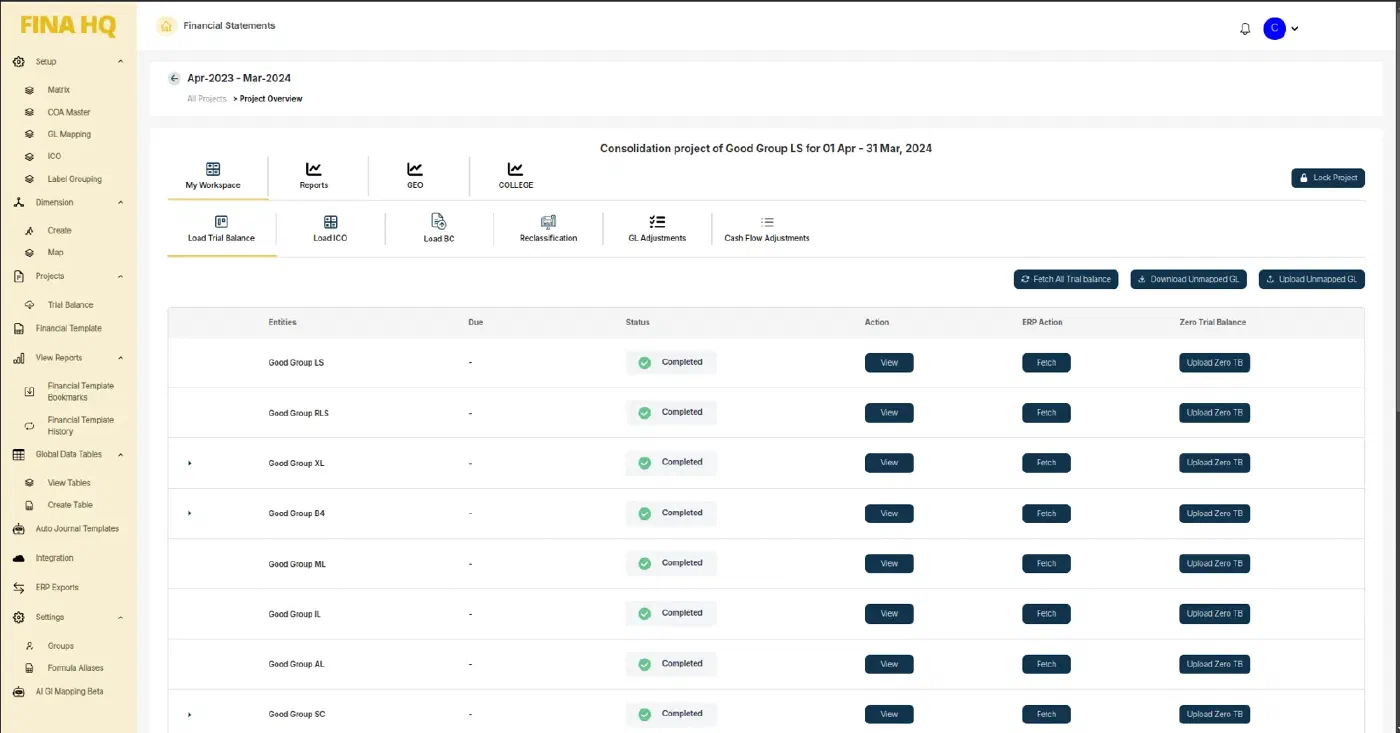
FINAHQ project workspace for a Good Group consolidation, 1 April 2023 to 31 March 2024, listing each company with its trial balance status marked Completed and buttons to view, fetch from the ERP or upload.
One workspace for the period. Every company's trial balance, its status and its ERP fetch in one list, next to intercompany, reclassifications and adjustments.
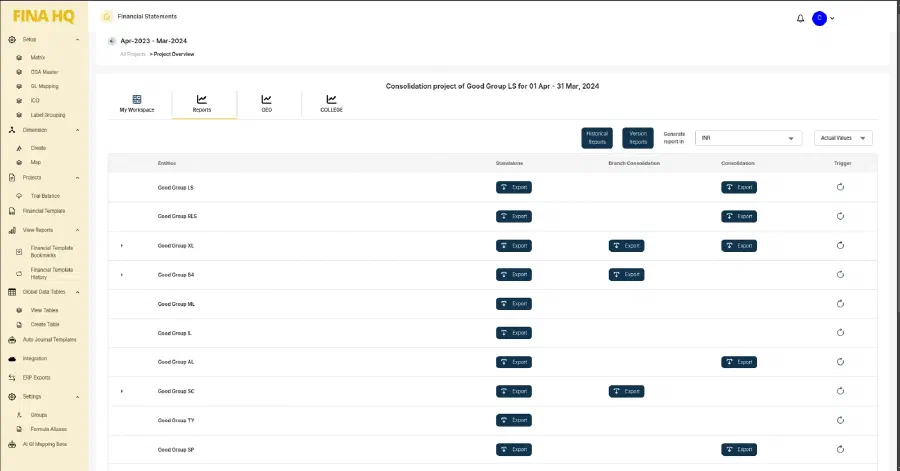
FINAHQ reports view listing Good Group companies with export buttons for standalone, branch consolidation and consolidation, and a currency selector set to INR.
Every statement, per company and consolidated. Standalone, branch and consolidated packs, out to Excel or PDF in the currency you choose.
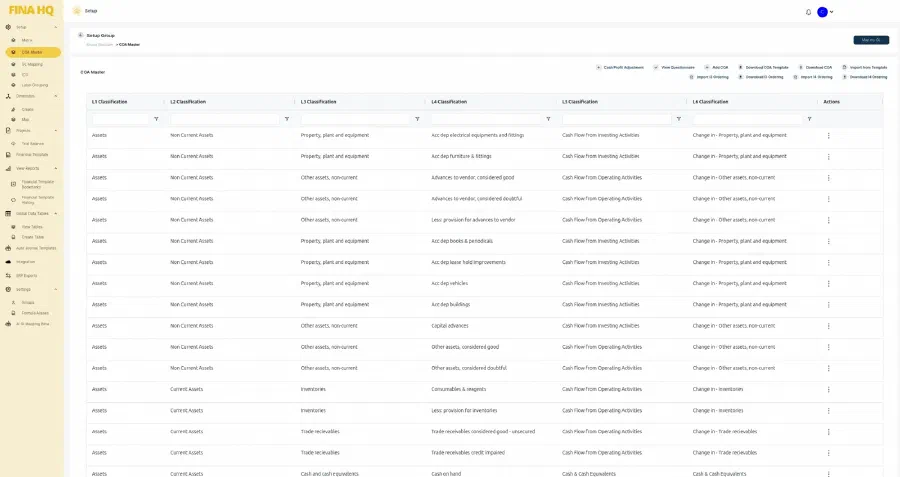
FINAHQ chart of accounts master, with six classification levels for each account, from Assets and Non Current Assets down to the cash flow line.
One chart of accounts for the group. Six levels, from the Schedule III line down to the cash flow line. Each ledger lands in the right statement once and stays there.
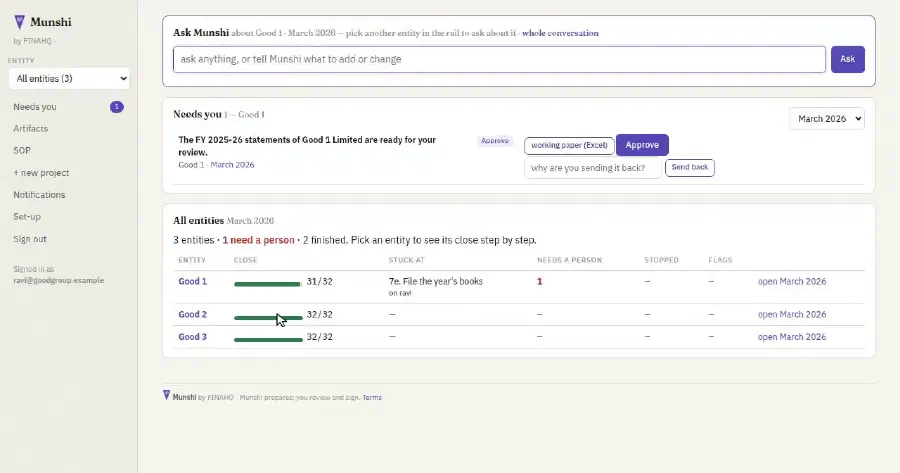
Munshi's group view for March 2026: Good 1 at 31 of 32 steps with one item needing a person, Good 2 and Good 3 at 32 of 32.
The whole group's close at a glance. Every company's progress, what it is stuck on, and the one thing that needs a person.
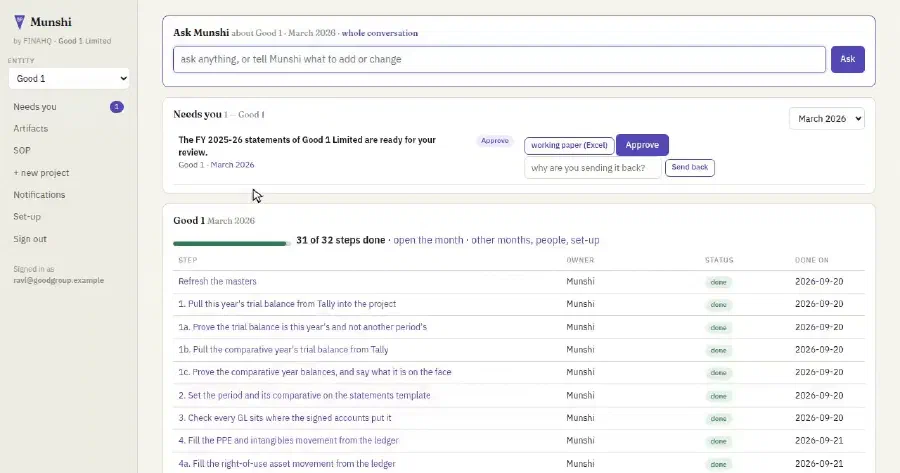
Good 1's close plan for March 2026 showing 31 of 32 steps done, each step with owner Munshi, status done and a completion date.
A 32-step close plan, run for you. Each step with its owner, status and date, from pulling the Tally trial balance to filing the year's books.
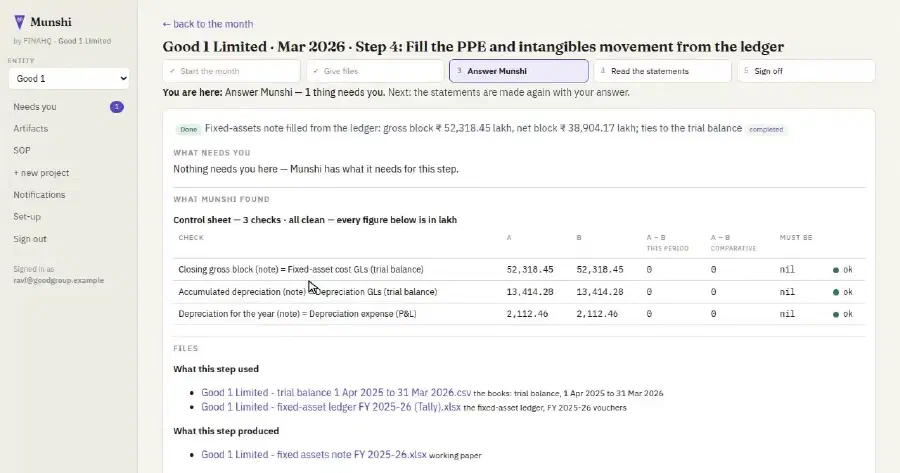
The step page for filling the PPE and intangibles movement, with a control sheet of three checks, all passing, and the source files listed.
Every figure checked against the ledger. A step's control sheet: both figures, the difference, and whether it passed, with the files it used and produced.
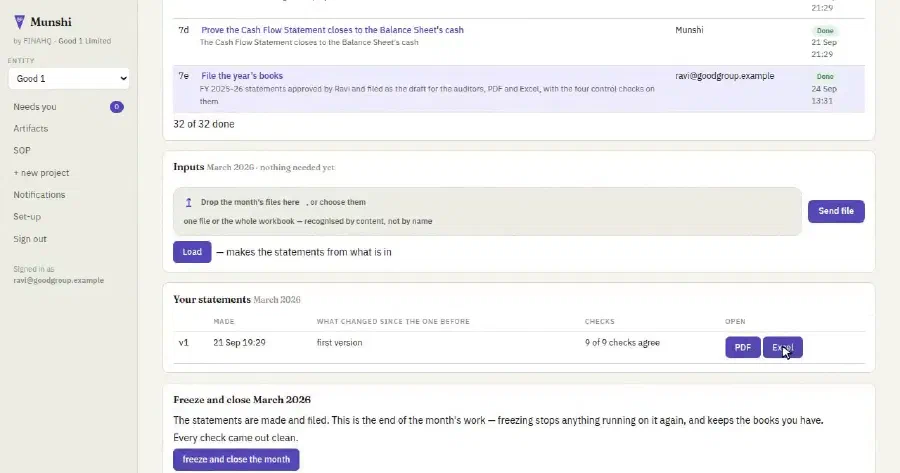
Good 1's March 2026 close complete at 32 of 32 steps, with the statements available as PDF and Excel and a button to freeze and close the month.
Statements ready to file. All 32 steps done, the statements out as PDF and Excel, and the month ready to freeze.

Where the days go

Your close, in a fraction of the time

6.4

fewer days on the close.

For a 7-person finance team closing 10 companies on TallyPrime. Every close, not just the first one.

10.0 days today, 3.6 days with FINAHQ. The calculator computes from your own answers.
Close, step by step
For a 7-person team closing 10 companies on TallyPrime, taking 10.0 days to consolidated numbers today. Measured on existing client engagements and approximate, not a promise. A different team size, company count or ERP mix is a different shape and these days should not be read across to it — the calculator computes from your own answers.
What the close is made ofDays todayDays with FINAHQDays savedWhat changes
Collect trial balances from every company1.50.51.0Nobody exports, emails or pastes a file. Trial balances and entries arrive from each ERP on a schedule, on their own.
Clean up and map ledgers to the group format1.50.51.0Nothing to re-map every month. FINAHQ proposes the mapping once from your signed accounts, your team approves it, and only new ledgers ever come back for a decision.
Chase companies and teams for schedules and confirmations1.00.40.6The chasing stops being your job. Munshi asks each owner directly for what only they have, follows up on its own, and keeps the approval record your auditors will ask for.
Match intercompany balances and agree differences1.50.51.0Your team spends its time agreeing differences, not hunting for them. Balances are matched across companies automatically and listed by counterparty.
Eliminations, currency translation and minority interest1.00.30.7Nothing recomputed by hand each period. Eliminations, translation and minority interest run from rules set once and are simply reviewed.
Draft balance sheet, P&L and cash flow1.00.20.8Statements are ready in your own format, in Excel, not assembled from scratch. They come straight from your approved Ind AS templates.
Prepare notes and disclosures1.50.70.8Most notes fill themselves from ledger and subledger data. What's left has a named owner and a sign-off, not a blank Excel tab.
Review, tie-out and audit queries1.00.60.4Audit questions get answered on screen, not chased over email. Every number opens down to company, ledger and entry.
Across the whole close10.03.66.4Each component's share of the reference close, multiplied by how much of that component is taken off. Your own team size, company count and systems change it, which is what the calculator is for.
Straight from the ledger, nothing typed
Mapped trial balance
Every ledger in every company, mapped once to the group format and reused every period. One company in a group we run carries more than three thousand ledgers.
Receivables ageing
Every debtor in its Schedule III bucket, with the total agreeing to the balance sheet line.
Payables ageing
The same for creditors, with the micro and small enterprises split the note has to show.
Fixed asset rollforward
Opening, additions, disposals and depreciation by asset class, tying to the gross block and accumulated depreciation on the balance sheet.
SOCIE
The statement of changes in equity, built from the movement in each equity and reserve ledger between two periods.
Cash flow
Built from the movement in mapped balances between two periods. Nothing is re-keyed from last year's workbook.
Related party
Transactions and balances by counterparty and relationship, from the entries already tagged in each company.

Where the month goes

Your monthly pack, in a fraction of the time

73% less time on the monthly pack, on average.

Averaged across our client work, for a group running its monthly pack on TallyPrime. Your figure depends on your systems — the calculator works it out.
The monthly pack, step by step
A monthly MIS pack, component by component. "Of the effort today" is how much of the pack that component takes; "taken off" is how much of that component stops being manual in the pack. Shown for a group on TallyPrime.
What the pack is made ofOf the effort todayTaken offWhat changes
Pull actuals from each ERP15% 70%Nothing to pull together. Actuals are already in FINK, refreshed from each ERP.
Allocate shared costs20% 80%No manual allocation spreadsheet. Costs split on drivers you set, such as headcount, area or revenue.
Cut numbers by division, plant, segment or customer20% 80%Every report is already cut the way you need it, by division, plant, segment or customer, defined once.
Compare against budget and explain variances15% 75%Variances are already explained by line and dimension. Budget sits alongside actuals, not in a separate workbook.
Put the pack into management's format15% 70%Your MIS workbook looks exactly as it does today. It just refreshes itself every month.
Answer follow-up questions15% 60%No more digging for a one-off answer. Follow-ups are asked in plain English and answered from the same numbers.
Across the whole month100%73%Each component's share of the month, multiplied by how much of that component is taken off. Your own dimensions and systems change it, which is what the calculator is for.

Integrations

Getting your data is the easy part

Reading your trial balance read-only, on the version you already run, is step one. The work is everything Munshi does with it after: closing, consolidating and building every disclosure your team used to key in by hand.

Tally

TallyPrime 4.x to 7.x, Tally ERP 9

Read-only, through Tally's XML interface

SAP

S/4HANA Cloud and on-premise 2020 to 2024, ECC 6.0 EHP6 and above

Read-only, through OData

Oracle

Fusion Cloud 23A to 24D, E-Business Suite R12.1 and R12.2

Read-only, through the GL Balances API

Oracle NetSuite

All NetSuite accounts

Read-only, through NetSuite's standard interfaces

Microsoft Dynamics

All versions, including Dynamics 365, NAV and Navision

Scheduled export

QuickBooks

QuickBooks Online, QuickBooks Online Accountant

Read-only, through OAuth 2.0

Zoho Books

All Zoho Books plans

Scheduled export

All integrations

Trust and deployment

What your IT team will ask

Read-only access, your own infrastructure if you want it, and an audit trail that goes back to the journal entry.

  • Read-only access to source systems
  • Role-based access
  • Audit trail to the journal entry
  • Encryption in transit and at rest
  • Self-hosting, including on-premise
  • Application-only access — no user has direct database access, and server, network and application accounts carry only the privilege their job needs
  • Accounts lock after repeated failed sign-ins
Security and deployment

See what this is worth to your group

Tell the calculator your entities, your systems and how long your close takes today. It shows its working.